

Closet Organization Wayfair: Closet Organization with Wayfair: What to Buy and How to Use It
Before you buy anything for your closet, you need one number: the depth. Not the width, not the height — the depth, measured from the back wall to where the door swings open. Get that number wrong and the organizer you ordered sits in the hallway for three weeks waiting for a return label.
This guide covers the actual process of closet organization, then matches specific Wayfair products to each step. The system comes first. The shopping comes after.
The Five Wayfair Closet Products Worth Ordering
Most Wayfair closet listings are generic products with interchangeable photos. These five have consistent reviews, clear specs, and a purpose that fits into a real organization system.
| Product | Price (approx.) | Dimensions | Weight Limit | Best Use |
|---|---|---|---|---|
| ClosetMaid SuiteSymphony Starter Tower | $149 | 25″W x 72″H x 14″D | 50 lbs per shelf | Reach-in closet anchor piece |
| Honey-Can-Do Double Hang Closet Rod | $38 | Adds 36″ of hanging space | 40 lbs total | Doubles rod capacity for shirts and jackets |
| Songmics 9-Cube Storage Organizer | $72 | 43″W x 43″H x 12″D | 25 lbs per cube | Walk-in closets, folded clothes, fabric bins |
| Whitmor Supreme Double Rod Closet | $59 | 36″W x 67″H x 18″D | 30 lbs per rod | Freestanding wardrobe for renters |
| Richards Homewares 24-Pair Shoe Rack | $35 | 36″W x 25″H x 12″D | Holds 24 pairs | Closet floor, flat shoes and boots |
When Modular Beats Standalone
The ClosetMaid SuiteSymphony is a modular system — you can add matching towers, drawers, and shelves from the same line as your needs grow. If you’re staying in your home long-term, modular is worth the slightly higher upfront cost. The pieces connect cleanly and expand without looking mismatched.
Standalone pieces like the Whitmor Double Rod are better for renters or anyone who doesn’t want a permanent setup. They’re easier to move, require no wall anchoring, and cost less. The tradeoff: they wobble more under heavy load and look more improvised.
What Wayfair Product Pages Don’t Tell You
Two things Wayfair listings consistently omit: assembly time and wall-anchor requirements. The ClosetMaid SuiteSymphony needs anchoring to a wall stud at 72 inches tall — it will tip forward without it. The listing photos show it freestanding. That is not a safe configuration.
Also: “laminate wood finish” means MDF or particleboard under a thin veneer. Fine for hanging clothes and light bins. Not fine for repeatedly loading 40 lbs of boots onto one shelf. For heavy loads, filter for products specifying “solid wood” or “steel frame.”
How to Measure Your Closet Before You Order Anything
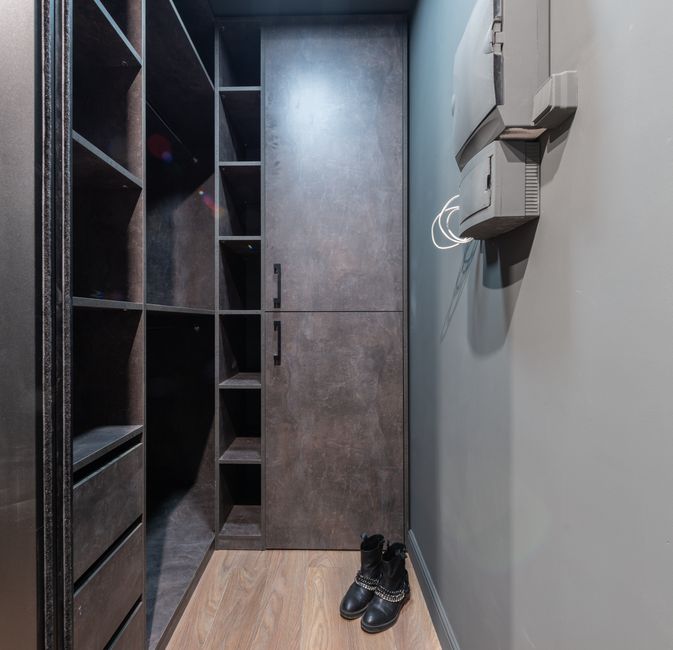
Ten minutes with a tape measure prevents a 10-day return wait. These are the exact numbers you need before you open a single product page.
The Three Measurements That Actually Matter
Most guides tell you to measure width and height. They skip the measurement that causes the most problems.
- Depth from back wall to door frame — This is the critical one. A standard reach-in closet is 24 inches deep. Many older homes run 18–20 inches. If a product is 20 inches deep and your closet is 18 inches, it sticks past the door frame and the door cannot fully close. Measure this before anything else.
- Width at both the top and the floor — Closets are rarely perfectly square. Measure at the top and at floor level. Use the smaller number as your maximum product width when shopping.
- Height from floor to ceiling, and floor to your existing rod — Floor-to-ceiling height determines whether a tower fits upright. Floor-to-rod height tells you how much vertical space is usable below the rod for floor storage or short shelving units.
Write these numbers down before you browse. Without them, you’re estimating. Estimates lead to returns.
Reach-In vs. Walk-In: Different Products Fit Better
Reach-in closets — typically 2–3 feet deep, one door width wide — are the standard bedroom closet in most homes built before 2000. They benefit from vertical organization: tall towers, double hang rods, and over-door organizers. The goal is height, not floor space, because there isn’t much floor space to use.
Walk-in closets have more floor space but are often wasted at the center. The most efficient layout is an L-shape or U-shape — shelving along two or three walls, with the center floor kept open for dressing. A cube organizer works well as a low center island in larger walk-ins, but only when the room is at least 6 feet wide.
The most common walk-in mistake: filling the center with a freestanding clothing rack. It blocks sightlines to everything behind it and makes the space feel cramped instead of functional. Keep the center open.
Weight Distribution — The Spec Nobody Reads Until Something Breaks
Every shelf has a per-shelf weight limit. What the listing doesn’t explain is that concentrating all the weight on one shelf stresses the entire unit’s joinery, even when the total unit capacity is higher. Place the heaviest items — boots, stacked sweaters, storage boxes — on the lowest shelf. This lowers the center of gravity and keeps freestanding units stable without requiring wall anchoring.
Five Steps to Build a Closet System That Stays Organized
Organization systems fail when they’re built around products instead of actual behavior. These five steps build the system first, then let the right products serve it.
- Empty everything out completely. Not reorganize in place — remove every single item and put it on the bed. This is the only way to see what you actually own and what the closet genuinely needs to hold.
- Sort into keep, donate, and discard. If you haven’t worn something in 12 months and it doesn’t serve a specific purpose — formal wear, seasonal gear, occasion clothing — it leaves. Fewer items means a simpler, cheaper organization system.
- Group by category, not by color. All pants together. All shirts together. All shoes together. Color coordination looks appealing in photos but slows down daily use. Category grouping is faster to navigate every morning when you’re running late.
- Decide what hangs and what folds before you buy a single product. Items that wrinkle badly — dress shirts, blazers, trousers, dresses — need to hang. Items that hold their shape folded — jeans, t-shirts, knit sweaters — can be shelved. This ratio tells you exactly how much rod space versus shelf space you need to buy.
- Buy products that match the system you’ve designed. You now have your three measurements, a layout plan, and a hang-to-fold ratio. Search with those numbers. Don’t browse for inspiration — search for solutions to the specific problem you’ve defined.
Step five is where Wayfair becomes useful. Not step one.
Wayfair vs. IKEA vs. The Container Store
For most people in most homes, Wayfair is the practical call. IKEA’s PAX wardrobe system is more durable and genuinely modular, starting at $150 for a single unit and scalable to full walk-in coverage — but it requires either a store trip or a 2–3 week delivery window. The Container Store’s elfa system is the strongest product available for a permanent closet build, starting at $300 and holding significantly more weight per shelf, but it works best with professional installation. Wayfair sits between the two: decent quality, ships fast, wide selection, manageable prices. For renters, guest rooms, or anyone who wants the project done this weekend, Wayfair is the right answer. If you own your home and are building a master closet you won’t touch for a decade, spend the extra money on elfa.
Three Buying Mistakes That Guarantee You’ll Reorganize Again in Six Months

The most expensive closet organization mistake is buying for the listing photo instead of your actual space. Wayfair product photos use staged closets with consistent lighting and generous dimensions. Your reach-in with the single overhead bulb is a different environment entirely — and it needs products sized for reality, not the showroom.
Buying Fabric Bins Without Checking for Internal Structure
Fabric cube bins are the most purchased — and most returned — closet product on Wayfair. Most collapse under real weight because they’re made of thin polyester felt with no internal support. Look for bins that specify a “cardboard insert,” “wire frame,” or “cotton canvas construction.” The StorageManiac Foldable Cubes ($28 for 6) hold their shape significantly better than most Wayfair house-brand alternatives. If you’re filling a Songmics or similar cube organizer, the quality of the bin matters as much as the quality of the frame.
Ignoring Door Clearance in Reach-In Closets
An organizer that sits one inch past your door frame makes it impossible to fully open the door. This happens constantly in reach-in closets where the door swings inward rather than sliding. Measure from the back wall to the point where your fully-open door rests. That is your actual usable depth — and it is almost always smaller than the interior closet measurement listed on any floor plan or listing.
Ordering Everything at Once Before Testing the Layout
Start with one piece — the tower or shelf unit that handles the highest volume of your clothing. Use it for two weeks. Your real organization habits become clear: where things pile up, what you reach for most, what the system is still missing. The second purchase will be more accurate and more useful than anything planned entirely in advance. Buying a full matched set in one order almost always means at least one piece that never finds a proper home.