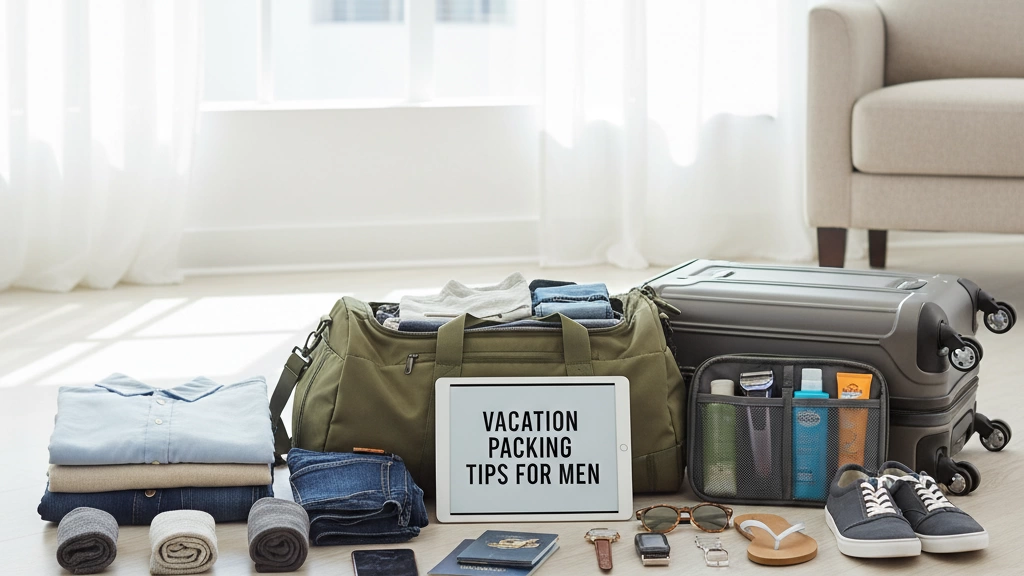

Vacation Packing Tips for Men Pack Smarter and Travel Light
You’ve got a week in Lisbon. You open your suitcase and it’s already full before you’ve packed shoes. That’s not a packing problem — that’s a system problem.
Once you have a repeatable method, packing light becomes automatic regardless of destination or trip length. Here’s the framework, broken into five parts.
The Capsule Wardrobe Formula That Covers Every Day
Most men pack one outfit per day. That logic produces a 28-pound checked bag for a seven-day trip. The fix is a mix-and-match wardrobe built around one formula: 5-3-2. Five tops, three bottoms, two shoes. That covers a full week with space to spare.
The rule every piece has to pass: it works with at least three other items in the bag. If a shirt only pairs with one specific pant, it doesn’t make the cut.
The 5-3-2 Breakdown
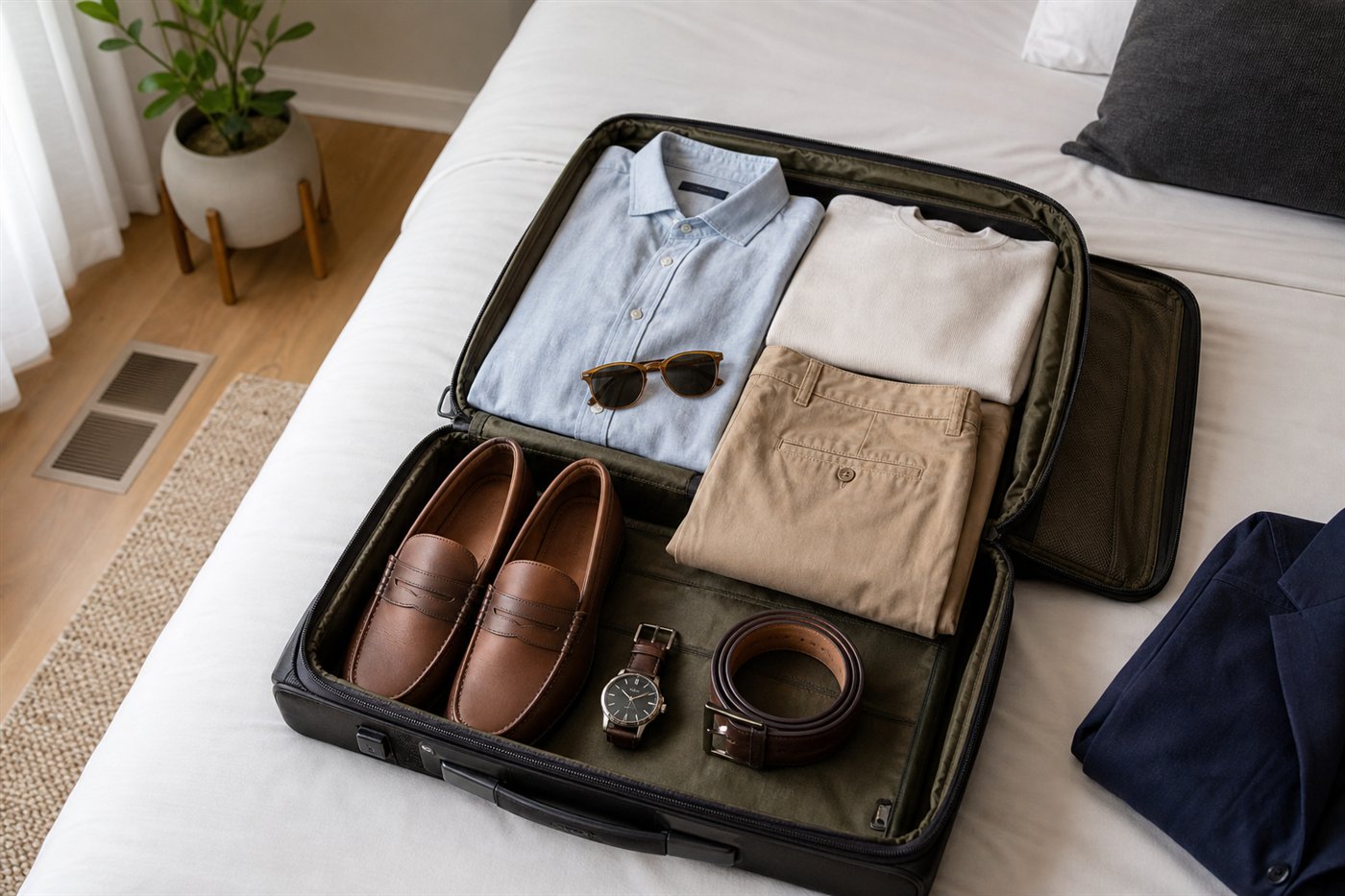
Five tops: two plain t-shirts in neutral colors (navy, grey, white), two button-downs (one casual Oxford, one slightly dressier), and one lightweight layer that doubles as a casual jacket for cool evenings and keeps you comfortable on the flight.
Three bottoms: one pair of dark slim chinos, one pair of shorts, one pair of technical travel pants. The Lululemon ABC Pant ($128) is the best travel pant available right now — wrinkle-resistant, stretchy enough for a transatlantic flight, and clean enough for a casual business meeting. Dark colors across all three mean they hide stains and read as more formal when needed.
Two shoes. That gets its own section below.
Why Fabric Choice Is the Real Variable
Standard cotton shirts need washing after every single wear. Merino wool shirts go two to three days between washes without developing odor. That changes the math significantly — three merino tops cover six days of wear.
The Unbound Merino T-Shirt ($65) is the clearest example in practice. Wear it two days in a row — the odor resistance is real, not marketing copy. The Wool& Long Sleeve Tee ($78) does the same job with a slightly dressier cut that works for casual dinners. Icebreaker’s Merino 150 line is a cheaper entry point at around $50 per top if you want to test merino before committing to the category.
For warm, humid destinations — Southeast Asia, the Caribbean, Central America — fast-drying synthetics outperform merino. The Patagonia Capilene Cool Trail Shirt ($55) wicks aggressively and dries in under two hours. Wash it in a hotel sink at night and wear it the next morning. That’s the practical loop for hot climates where you’re sweating through everything daily and merino’s odor resistance stops mattering.
Cold-weather layering: the Uniqlo Ultra Light Down Jacket ($69.90) packs into its own pocket, weighs about 320g, and handles temperatures down to the low 40s°F. One jacket. Stop there.
Handling a Formal Event Without Adding a Bag
Bring a navy blazer and wear it on the plane. A navy blazer over dark chinos is business casual in virtually every setting outside black-tie. If the trip includes one formal dinner, that combination handles it. The blazer takes a dress shirt’s slot in the packing list — it doesn’t add one.
If a full suit is genuinely unavoidable, roll it inside a dry-cleaning bag within your main luggage. The plastic sheet reduces friction between fabric layers and cuts wrinkles significantly better than bare rolling or folding flat.
The Packing Gear Worth Buying
A lot of gear is marketed at travelers without solving a real problem. Here’s what actually earns its place in the bag — and what doesn’t.
| Product | Type | Price | Best For | Verdict |
|---|---|---|---|---|
| Eagle Creek Pack-It Specter Cubes | Packing Cubes | $35–$55 (set) | Organized clothing, lightweight travel | Best overall pick |
| Peak Design Packing Cube (Medium) | Packing Cubes | $59 | Peak Design bag owners | Best within that ecosystem |
| Sea to Summit Compression Sack | Compression Bag | $25–$40 | Bulky jackets, down outerwear | Skip for clothes; use for one jacket |
| Osprey Farpoint 40 | Travel Backpack | $200 | 1–2 week active trips, carry-on only | Best value travel pack |
| Away Carry-On (Bigger Carry-On) | Hard Shell Suitcase | $295–$345 | Business travel, structured city trips | Best for frequent business fliers |
| Peak Design Travel Bag 45L | Travel Backpack | $299 | Camera and tech-heavy travelers | Overkill unless carrying serious gear |
Do Packing Cubes Actually Save Space?
No. Packing cubes don’t compress clothing. What they do is organize it — and that organization makes overpacking visible and harder to do. When clothes are sorted into cubes, you see immediately when you’ve gone too far.
The Eagle Creek Pack-It Specter set is the standard recommendation for a reason. The ultralight versions weigh under 25g per cube, hold up to years of travel, and cost under $55 for the full set. Avoid thick-walled cubes from Tumi or Briggs and Riley — you’re paying for branding and adding dead weight.
Compression bags are a different category and largely overhyped for clothing. The Sea to Summit Compression Sack ($25–$40) genuinely works for one bulky jacket or down gear, but using it on stacks of t-shirts mostly produces tightly wrinkled shirts with maybe 20% volume savings. That trade-off usually isn’t worth it.
Backpack or Hard Shell: How to Pick
For active trips under 12 days: the Osprey Farpoint 40 ($200). It fits most airline carry-on requirements (54x36x23cm when fully packed), has a dedicated laptop compartment, and panel-loads so you can access everything without unpacking the entire bag. The shoulder straps tuck away cleanly for conveyor belts — small detail that matters after the third flight of a trip.
For business travel or structured city stays: the Away Carry-On ($295). The hard shell protects blazers and dress shirts better than any soft-sided bag. It also rolls cleanly on marble hotel floors where a backpack’s dangling straps become a liability.
The Peak Design Travel Bag 45L ($299) is excellent if you carry camera gear or heavy tech equipment. For everyone else, it’s an expensive solution to a problem you don’t have.
Five Things Men Always Overpack
Every man makes these mistakes for the first several trips. The pattern is identical every time: packing for a hypothetical scenario rather than a confirmed itinerary. Cut these five things and you’ll free up roughly half the bag.
- Full-size toiletries. A 500ml shampoo bottle for a five-day trip is genuinely common. Hotels provide shampoo. Every pharmacy worldwide sells it. Refillable 100ml travel bottles (the Matador FlatPak Soap Bar Shaker at $18 handles most liquids well) or buy on arrival. This single category frees up 400–600g of pack weight.
- The third pair of shoes. Packed for an event that might happen. It almost never does. When it does, you wear what you brought or buy cheap shoes locally. The third pair earns zero wear on the vast majority of trips.
- Excess denim. Jeans weigh 600–800g per pair and take over 24 hours to air dry after washing. One pair maximum, dark wash so they read as clean longer. Everything else should be chinos or technical travel pants that weigh half as much and dry overnight.
- Multiple jackets. The Patagonia Nano Puff Jacket ($249) weighs 311g and handles temperatures down to approximately 40°F. That’s one jacket. Not the fleece plus the rain shell plus the down layer — one jacket, full stop.
- Physical books. A single paperback weighs 300–500g. A Kindle Paperwhite ($139) weighs 205g and holds your entire reading list. The math is not complicated. Men still pack the paperback.
“Just in case” is the most expensive phrase in travel packing. Every item needs a confirmed use before it goes in the bag. If it can’t name its role, it stays home.
The Shoe Problem Has One Solution
Two pairs. No exceptions. The Allbirds Tree Runner ($125) handles walking, casual dinners, and light urban hikes — it also doubles as a light trail shoe on packed surfaces, so you’re not giving up outdoor capability. The Cole Haan ZeroGrand Wingtip ($200) handles anything requiring a polished look: business meetings, nicer restaurants, formal events. Together they weigh less than most single hiking boots and cover every realistic vacation scenario without a cubic inch of wasted bag space.
When Carry-On Only Is the Wrong Call
Carry-on only is the right default. But knowing when to check a bag is as useful as knowing how to pack light.
How long is carry-on only actually viable?
Two weeks or under: completely doable with the clothing framework above and one laundry session mid-trip. Three weeks or more depends almost entirely on laundry access, not trip length.
The real variable is laundry cadence. Hotels offer 24-hour turnaround in most cases. Airbnbs usually have washing machines. Moving cities every 48 hours compresses your laundry windows significantly. The practical plan: pack five days of clothing, do one load of laundry, repeat. The math works regardless of how long you’re gone.
What’s the actual TSA 3-1-1 strategy for a week-long trip?
One quart-size zip bag of liquids, each container at 100ml or under. That covers travel shampoo, face wash, and one liquid product you can’t substitute. Everything else should be solid format — solid deodorant, bar soap, powder sunscreen. These are widely available and cut the liquid burden entirely.
Cologne is where men consistently burn their liquid allowance. A 10ml roller ball or cologne sample covers a full week of wear. A 100ml glass bottle takes up a third of the liquids bag and risks breaking in transit. It’s not worth carrying.
What if your airline enforces strict carry-on size limits?
Budget carriers play hardball with bag sizes. Ryanair’s personal item allowance is 40x20x25cm — most standard travel backpacks don’t clear that dimension. Southwest has no practical carry-on size enforcement on most domestic routes. Ryanair will charge you €50 at the boarding gate if your bag doesn’t fit their metal sizer. That’s not a risk, that’s a guarantee if you show up with a full-size travel pack.
Check the specific airline’s published size policy before buying any travel bag. A bag that flies free on Delta might trigger a gate fee on Wizz Air. Five minutes of research before booking beats a miserable conversation at the boarding gate every time.
Men who travel frequently and do it without stress haven’t found some secret minimalist philosophy — they built a repeatable system and stopped reinventing the packing list each trip. The gear keeps getting better: lighter fabrics, smarter compression, bags designed around real airline limits. The barrier to traveling carry-on only is lower right now than it’s ever been. Build the system once, run it twice, and after that packing for any destination takes 20 minutes.