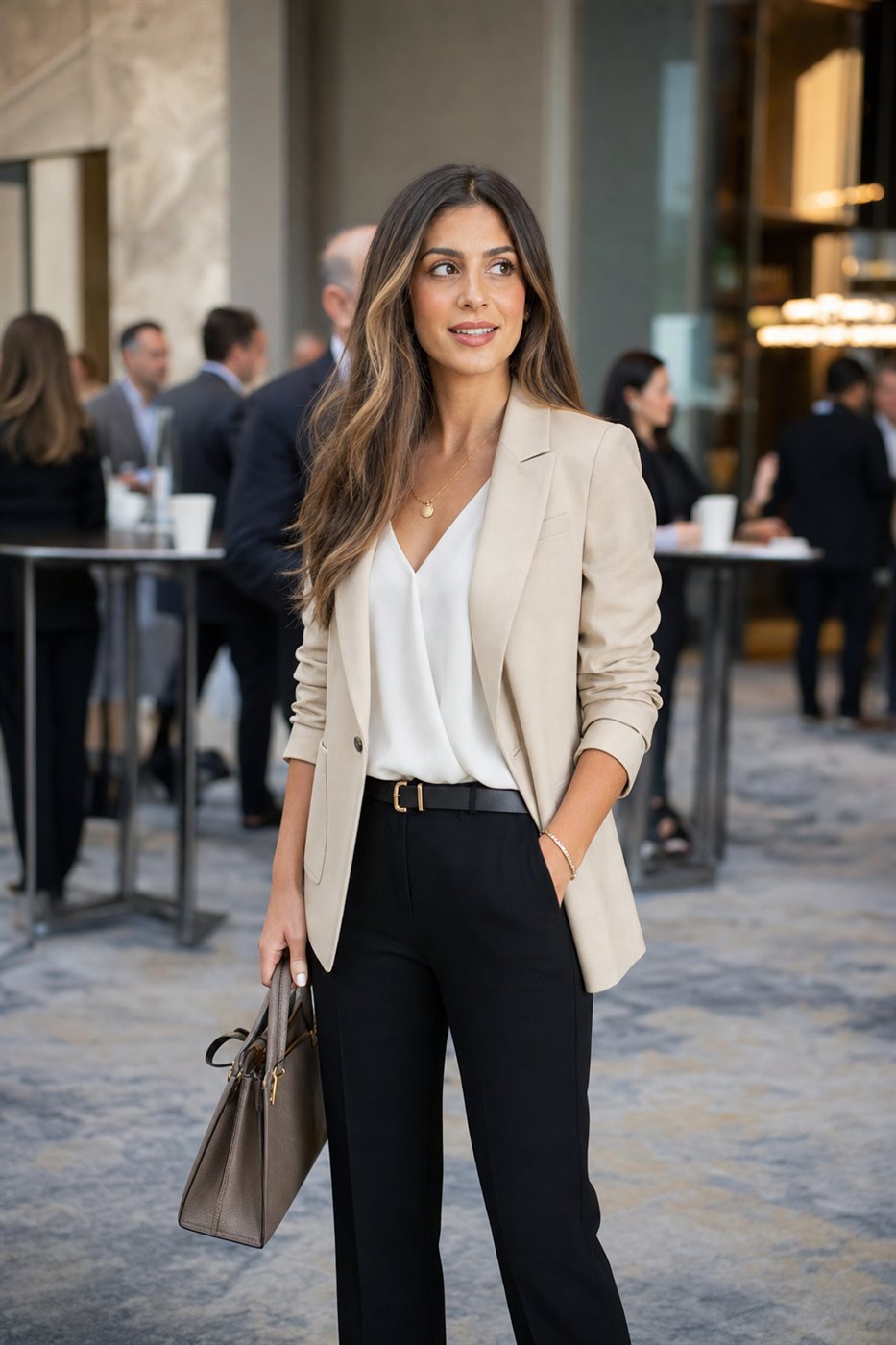


How to Dress for Networking Events Style Tips for Success
Princeton University researchers found that people form lasting impressions of a stranger’s competence in approximately 100 milliseconds — faster than the blink of an eye. At a networking event, where you’re competing for attention in a room full of ambitious professionals, your clothing makes that argument before your handshake does.
This is not professional styling advice — consult a licensed image consultant or personal stylist for specific occasion recommendations.
Why Clothing at Networking Events Functions as a Silent Credential
Most career coaches and image consultants generally observe that networking attire serves a dual purpose: it signals professional standing and signals that you took the event seriously. Neither is trivial.
In most professional industries, the implicit dress standard at networking events sits between what you’d wear to a job interview and what you’d wear to a casual Friday office. That range is wide — and navigating it incorrectly typically costs you the benefit of the doubt in early conversations before you’ve said a word.
The 100-Millisecond Problem
Social psychologists call it “thin-slicing” — the brain’s ability to extract meaning from minimal information. When someone sees you across a conference room, they’re not consciously evaluating your blazer. They’re running a background process that associates visual signals with social categories. Intentional dressing doesn’t guarantee a positive impression, but it removes the most common sources of negative ones.
The research on this is fairly consistent: people perceived as “dressed appropriately for the context” are generally rated as more competent and approachable than those perceived as over- or under-dressed — regardless of their actual qualifications. That asymmetry matters because you can’t unring that bell mid-conversation.
Industry Signals vs. Personal Style
Personal style and professional signaling aren’t the same thing, and conflating them is one of the most common mistakes at networking events.
A graphic designer attending an ad-agency mixer can typically wear something more expressive than a financial analyst attending a CFA Society event — and both would be “dressing appropriately.” The standard isn’t universal. It’s contextual. Most style advisors generally recommend calibrating to the industry first, then expressing individuality within those parameters.
There’s also the question of what your clothing says about your judgment. If you arrive at a formal industry dinner underdressed, most attendees won’t think “bold.” They’ll think “didn’t do the research.” That inference — fair or not — typically follows you into the first three conversations of the evening.
Dress Code Translation Guide for Networking Events
Invite language is rarely precise. “Smart casual” means something different at a tech startup than it does at a law firm alumni mixer. The table below reflects generally observed interpretations across professional contexts — not absolute rules, as industry culture can shift these benchmarks significantly.
| Invite Says | What It Typically Means | Men’s Benchmark | Women’s Benchmark |
|---|---|---|---|
| Business Formal | Suit and tie required; no exceptions | Dark wool suit, white shirt, silk tie | Tailored pantsuit or formal sheath dress |
| Business Professional | Suit strongly preferred; polished and conservative | Navy or charcoal suit, tie optional | Blazer + trousers or structured dress |
| Business Casual | No jeans; no tie required; still polished | Chinos + button-down + blazer | Blouse + tailored trousers or midi skirt |
| Smart Casual | Clean, intentional; elevated but relaxed | Dark jeans + collared shirt or sweater | Clean jeans + structured top or wrap dress |
| Casual | Rare for professional events; usually tech or startup | Neat jeans or chinos + clean polo or tee | Neat jeans + blouse or clean knit top |
When the Invite Gives No Direction
Default to business casual. Most professional networking events, regardless of industry, land in that range. It’s the sartorial equivalent of arriving five minutes early — nobody penalizes you for it, and it signals preparation over indifference.
If the event is hosted by a specific firm or organization, look at their LinkedIn page. How do employees dress in their profile photos? That’s your baseline target. Organizations that consistently post photos of staff in suits are telling you something. So are ones where the team photos show jeans and hoodies.
How to Read the Room in Real Time
Arrive within the first 20 minutes. The people there early tend to be the organizers and the most intentional attendees — and you’ll see the actual dress standard before the room fills. If you realize you’ve misjudged the occasion, you have time to calibrate expectations for the next event rather than spending the evening self-conscious about your jacket.
Five Outfit Mistakes That Quietly Damage Your Credibility
Most of these aren’t about looking bad. They’re about introducing friction into the professional conversation before it starts.
- Wearing uncomfortable shoes. You will stand for two to three hours. If your feet hurt by the 45-minute mark, your posture changes, your energy drops, and your face shows it. Comfort is a strategic requirement, not a concession. Women’s block heels or leather flats from Clarks or Sam Edelman hold up across a four-hour evening better than fashion-forward stilettos. Men’s leather Oxford shoes from Thursday Boot Company’s Cambridge line (~$199) or Allen Edmonds’ Park Avenue (~$395) outlast most fashion-forward dress shoes on a full evening of standing.
- Overdressing by exactly one tier. A full black-tie look at a business casual event doesn’t signal formality. It signals you didn’t understand the room. Overdressing by one level creates social distance and can read as performative rather than professional — neither impression helps you build genuine connections.
- Wearing clothes that need constant adjustment. A too-tight collar. A skirt that rides up. A jacket that pulls across the shoulders. If you’re adjusting your clothing every 10 minutes, you’re not fully present in the conversation. Most style consultants generally advise a 15-minute “sit-stand-walk” test at home before any professional event.
- Loud patterns near the face. A bold geometric tie or high-contrast printed collar draws the eye away from your face during conversation. For networking — where you want people to remember what you said, not what you wore — most image consultants generally recommend keeping the top third of your outfit subdued and the personality lower.
- Forgetting functional requirements. Business cards go somewhere. A phone needs a pocket. A name tag will be applied to your upper chest. Silk blouses that gather awkwardly around a name tag, suits with no internal pockets, and jackets that hang wrong when you reach for a card are entirely avoidable points of friction in an already high-stakes environment.
The Wardrobe Pieces That Work in Every Networking Context
The goal isn’t a separate “networking wardrobe.” The goal is identifying the pieces — or acquiring a small number of high-utility items — that work across the widest possible range of professional contexts without requiring you to own a different outfit for every scenario.
For Women: What Actually Works
A well-fitted blazer is the single most versatile investment for professional networking. The Banana Republic Ponte Blazer ($150–$180) holds its shape through a full evening and reads as polished without being stiff. M.M. LaFleur makes a range specifically engineered for professional wear with extended standing and sitting — their Brady Blazer at around $195 gets consistent positive reviews from women in client-facing careers across industries.
Pair it with tailored trousers or a midi skirt rather than a bodycon dress. The point is to look put-together, not dressed for a different kind of evening.
For shoes: the Sam Edelman Hazel block heel (~$90) appears in professional style guides repeatedly for combining visual polish with actual wearability. For flats, the Cole Haan Tali Grand Bow flat (~$100) holds up across a four-hour event better than most fashion-forward alternatives. Both are available at major department stores and won’t require breaking in before you wear them.
For Men: The Reliable Framework
Navy blazer. Grey or charcoal chinos. White or pale blue Oxford shirt. That combination works at roughly 80% of professional networking events across industries, in most major cities, at most seniority levels.
You can dress it up with leather Oxford shoes when the event skews formal, or wear clean white sneakers when it skews creative or tech. The J.Crew Ludlow Slim-Fit Blazer in wool (~$300) has held a consistent reputation in men’s professional style circles for fit and durability over multiple seasons. Banana Republic’s Non-Iron Slim-Fit Oxford shirt (~$70–$80) eliminates the “wrinkled at hour two” problem entirely — a real concern at evening events after a full workday.
Where to Buy Without Overspending
A complete, event-ready networking outfit typically runs $200–$400, not $800. Zara’s tailoring line offers blazers at $80–$120 that hold their shape well for most business casual contexts. Uniqlo’s Oxford button-downs ($30–$40) and slim-fit chinos ($40–$50) form the foundation of many professional wardrobes at every income level — their fit standards have improved meaningfully in recent years and they photograph well in most lighting.
Where most style consultants generally advise against spending: fast-fashion brands for structured pieces. Blazers and trousers from fast-fashion retailers typically lose their shape after a few wears, which makes them a poor value even at low price points. Trend-forward items that will look dated within 18 months are similarly poor investments for professional contexts.
What to Wear Based on Event Type
Tech industry mixer vs. finance conference — are the rules the same?
No. These industries have measurably different visual cultures. At a tech startup mixer, a structured blazer over a clean t-shirt is typically received well — it reads as intentional without being stiff. At a CFA Society dinner or investment banking alumni event, business formal or polished business professional is the default. Showing up in a smart-casual outfit to a finance networking event typically signals that you either didn’t know or didn’t care about the industry norms — and neither interpretation helps you.
Legal and consulting events generally land in the business professional range. Healthcare conferences vary by specialty — clinical settings trend conservative; healthtech and biotech skew closer to tech norms. When in doubt, review three or four LinkedIn profiles from people who regularly attend the specific event.
Morning coffee meetup vs. evening cocktail event — is there a meaningful difference?
Yes, and the gap is larger than most people expect. Morning networking events — coffee meetups, breakfast roundtables — typically run business casual or even smart casual. Evening cocktail events almost always call for at least smart casual, and many require business professional or above. The time of day functions as a social signal about the formality of the occasion, and dressing against that signal is noticed.
Evening events also introduce venue as a variable. A hotel ballroom and a startup loft carry different dress expectations even for the same time slot. If the venue is formal, adjust upward regardless of what the invite language says.
Virtual networking calls — does attire still matter on camera?
Solid, medium-toned colors photograph better than patterns on most webcams. Navy, burgundy, forest green, and camel all read as professional on screen. White tends to blow out under certain lighting setups. The top third of your outfit — roughly blazer lapels to collar — is what the camera frames most of the time, so that’s where intentional dressing pays off most directly.
Most image consultants generally recommend treating virtual networking with the same preparation as in-person events. Your first impression is still being formed through a lens, even if it’s a laptop camera in a home office.
The Outfit Formula That Rarely Fails
One blazer in a neutral — navy, charcoal, or camel — paired with one set of tailored trousers or chinos, one polished flat or low-heeled shoe, and one simple accessory. That’s the whole formula. It works across industries, event types, and seniority levels because it signals preparation without signaling try-hard.
The Princeton researcher who found that judgments form in 100 milliseconds also found something less frequently cited: when subjects were given more time and more information, their first impressions rarely changed. The person who spent 20 minutes choosing an intentional outfit before that networking event typically ends the evening being remembered for their ideas, their conversation, and their follow-up — not their wardrobe. That invisibility is exactly the point.